Creative Art Activities That Teach Math
Seven activities that use paint, paper and beads to teach symmetry, fractions, patterns and measurement.
Art activities are often sold to parents as a painless way to sneak maths past a reluctant child. That undersells them. Drawing a shape is a genuinely different mental act from naming one, and a child who has folded a butterfly painting understands a line of symmetry in a way that a child who has only labelled one does not.
The activities below all use materials you already have. Each one lists the maths it actually trains, so you can pick the one that matches what your child is working on rather than doing all seven.
1. Symmetry paintings
Trains: lines of symmetry, reflection · Ages: 6–9
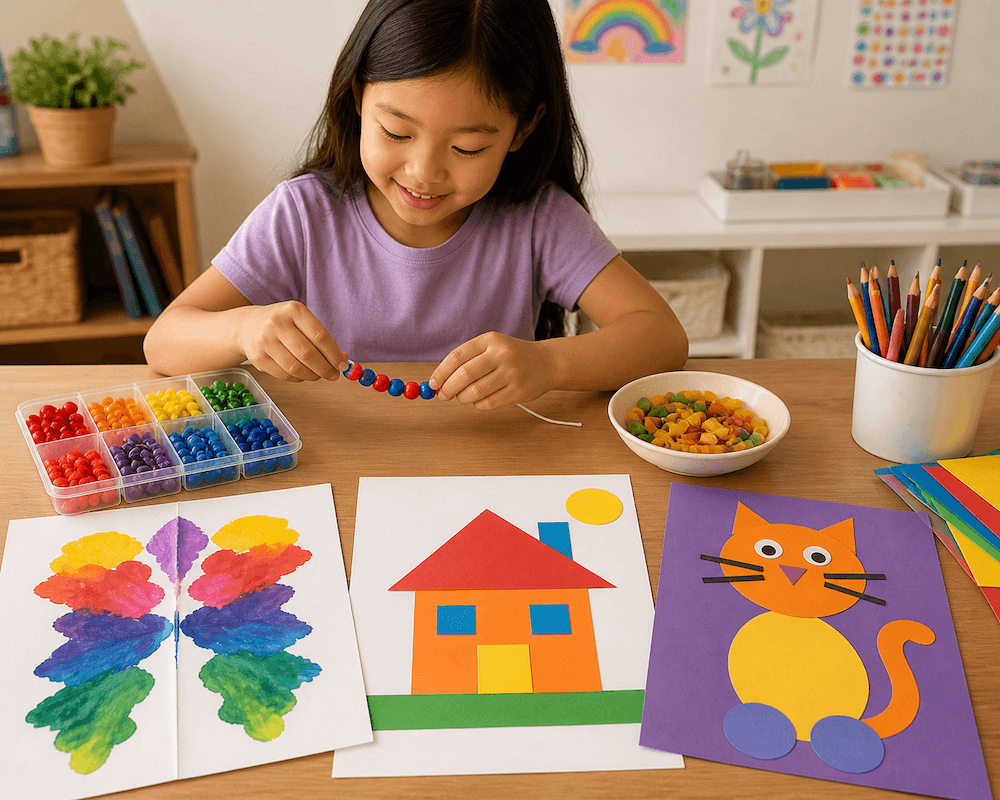
Fold a sheet of paper in half, paint on one side only, then press the halves together and open it out. The result is symmetrical by construction, which makes the fold line visible as the thing that produced it.
Once the paint is dry, ask where the line of symmetry is, and then whether there is more than one. Most butterfly paintings have exactly one, and noticing that a square has four is a genuinely surprising follow-up.
2. Pattern necklaces
Trains: repeating patterns, early algebra · Ages: 6–8
Thread coloured beads or painted pasta in a repeating sequence — red-blue-red-blue, or a three-step ABC-ABC. Then start a pattern yourself and ask your child to continue it.
This is the foundation of algebraic thinking: a rule that generates a sequence. The step worth pushing for is getting them to state the rule out loud rather than continuing it by feel.
3. Shape collages
Trains: naming 2D shapes, properties · Ages: 6–8
Cut geometric shapes from coloured paper and arrange them into a picture — a house from rectangles and triangles, a cat from circles and ovals.
Ask how many sides and corners each piece has as it goes down. It turns a craft into vocabulary practice without stopping the craft.
4. Measurement self-portraits
Trains: measuring in cm, comparing lengths · Ages: 7–9
Draw a person or a creature using only a ruler — every line measured and recorded before it is drawn. How long are the arms? How wide is the head?
The useful constraint is having to decide the number before drawing the line. It turns measurement from something you check afterwards into something you plan with.
5. Fraction pizzas
Trains: halves, thirds, quarters, equivalence · Ages: 7–10
Draw circular "pizzas" and divide them into halves, thirds, quarters, sixths and eighths, colouring each slice differently. Then "serve" portions to toys or family members.
This is the fastest route to the fact most children find genuinely counter-intuitive: that 1/8 is smaller than 1/4, even though 8 is bigger than 4. Seeing the slices side by side settles it in a way that being told does not.
6. Tessellating tiles
Trains: shape properties, angles, area · Ages: 8–11
Cut a set of identical shapes — squares, triangles, hexagons — and try to tile a sheet of paper with no gaps. Then try with pentagons, which will not work.
Working out why some shapes tessellate and others do not is real geometric reasoning, and it lands much harder when the child has just spent ten minutes failing to make pentagons fit.
7. Scale drawings
Trains: ratio, proportion, multiplication · Ages: 9–11
Take a small picture and redraw it twice the size, using a grid to keep the proportions. Every measurement doubles; every relationship stays the same.
This is proportional reasoning in its most visible form, and it is a topic that gives a lot of children trouble on paper while being obvious on a grid.
Why art-based activities work
It is tempting to explain this with something about "engaging both sides of the brain". The real reason is simpler.
First, the maths becomes the means rather than the end. A child folding a symmetry painting is trying to make a nice butterfly; the symmetry is how they get one. That changes what failure feels like — a wonky fold is a craft problem, not a wrong answer.
Second, the result is physical and stays around. A fraction pizza on the fridge gets referred back to for weeks. A completed worksheet does not.
Third, and most usefully, these activities make a child's thinking visible. When they cut a circle into "quarters" and the pieces are obviously different sizes, you can see the misconception rather than having to infer it from a wrong answer.
Getting the most out of them
- Talk while making, not after. The questions land better mid-activity than as a debrief.
- Ask for the rule, not the result. "What's the pattern?" is worth more than "what comes next?".
- Let the mistake finish. A pizza cut into unequal quarters is a better teaching moment than one you corrected halfway through.
- Do not do all seven. One activity that gets returned to beats a themed week that exhausts everyone.
Where these fit in the curriculum
Symmetry, 2D shape properties and patterns sit in the geometry modules for ages 6–7 and ages 7–8. Fractions run from ages 7–8 through to ages 10–11, and tessellation and scale drawing belong with the geometry and ratio work at ages 10–11.
If you want structured practice alongside the craft, the free printable worksheets cover the same topics on paper with a full answer key and no account needed.