The Human Body Systems, Explained for Kids: Digestive, Respiratory, Circulatory and Nervous
What each organ actually does, where food and air really go, and the questions every child ends up asking.
Ask a nine-year-old to name the organs and you will usually get heart, brain, lungs, stomach — and then a pause. Ask them what those organs are *for*, and how they work together, and the pause comes much sooner.
That is the real difficulty with the human body at primary school. The names are the easy part. What takes longer to click is that organs do not work alone: they work in teams, and each team has one job.
What a "body system" actually means
A system is a group of organs that share one job.
The stomach does not digest your lunch on its own. It is one stop on a route that starts at your mouth and ends at the toilet, and every organ on that route has a task. Together they are the digestive system. The same is true of breathing, of blood, and of everything your brain controls.
This is why "learn the organs" is the wrong instruction and "follow the journey" is the right one. A child who can tell you where a piece of apple goes, in order, understands more than a child who can list fifteen organs in no particular order.
Here are the four systems primary school covers, each as a journey.
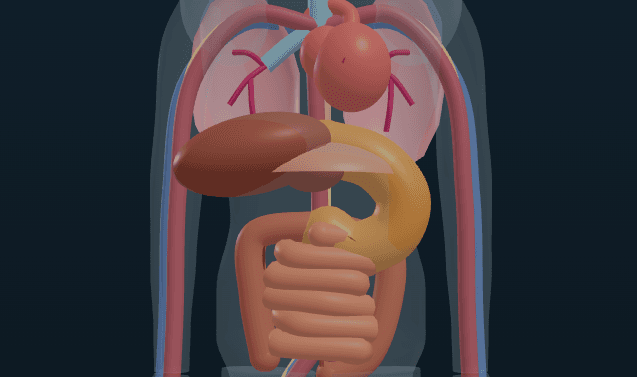
The digestive system: the journey of your food
Food takes a single long route through your body, and something happens to it at every stop.
- Mouth — teeth cut and crush; spit starts breaking the food down before you even swallow
- Food pipe (oesophagus) — squeezes the food downward, like squeezing a tube of toothpaste
- Stomach — a stretchy bag that churns everything with very strong juices until it is mush
- Small intestine — where your body actually takes the vitamins and the energy out of the food
- Liver — helps along the way; it cleans your blood and makes a juice that breaks down fat
- Large intestine — takes back the water that is left and gets the rest ready to leave
The small intestine is the one that surprises people. Stretched out it would be about six metres long — longer than three children lying head to toe in a row. It is coiled up in your tummy precisely because it has to be.
The respiratory system: how air gets in
- Nose — tiny hairs and mucus filter the air, and warm it up on the way in
- Windpipe (trachea) — a tube with stiff rings, like a vacuum cleaner hose, so it cannot squash shut
- Lungs — two spongy bags that take oxygen out of the air and let the used air back out
- Diaphragm — a flat muscle under the lungs that drops to let air in and rises to push it out
The diaphragm is the part most children have never heard of, and it is the one doing the work. You do not breathe with your lungs so much as *into* them. And here is the detail that always lands: the left lung is smaller than the right one, because it has to leave room for the heart.
The circulatory system: the delivery service
- Heart — a muscle about the size of your own fist, in the middle of your chest, tilted slightly to the left
- Blood vessels — arteries carry blood away from the heart, veins bring it back
Blood is a delivery van that never stops. It drops oxygen and food at every corner of your body, picks up the waste, and comes back for more. Your heart beats about 100,000 times a day doing it — including while you are asleep.
The nervous system: the wiring
- Brain — the boss: it thinks, remembers, feels, and gives the orders
- Spinal cord — a thick cable of nerves running down inside your backbone
- Nerves — thin threads reaching all the way to your fingers and toes
Messages travel along your nerves at more than 100 kilometres per hour. That speed is why the next section's first question has such a satisfying answer.
The questions children always ask
Why do you pull your hand away before you feel the pain?
Because your hand does not wait for your brain. Touch something hot and the message runs up your nerves to the spinal cord, which sends "move!" straight back down without consulting anyone. The brain finds out a moment later — which is why you notice the pain *after* you have already moved. That shortcut is called a reflex, and it exists because a fraction of a second matters when something is burning you.
How many organs does the human body have?
About 78, depending on who is counting and how small a thing you are willing to call an organ. Only five are ones you truly cannot live without: brain, heart, lungs, liver and kidneys. That gap between 78 and 5 is usually more interesting to a child than either number on its own.
What is the biggest organ?
The skin. It is easy to forget it counts, but it is an organ like any other, and it is bigger than all the rest. The biggest one *inside* the body is the liver.
Why does your heart beat faster when you run?
Your muscles are burning through oxygen, so they need blood delivered more often. The heart is not panicking — it is speeding up the delivery van because the orders got bigger. This is also why you breathe faster: more oxygen has to come in for the blood to carry.
What are hiccups?
Your diaphragm jumping without warning. That sudden pull yanks air in, your throat snaps shut on it, and the noise is the result. Nothing is wrong; the muscle simply twitched.
Why does your tummy rumble?
Your stomach and intestines squeeze even when they are empty, and with no food inside them there is only air and liquid to push around. The rumble is that, echoing in a space that happens to be hollow.
How to actually teach this at home
Follow one journey per sitting. Trace the food, or the air, or the blood — start to finish, out loud. One system, then stop. Four systems in one evening is how you end up with a child who remembers none of them.
Ask them to explain it back, pointing. Where does the apple go first? And then? Pointing at their own body while they say it does more than any diagram, because it converts an abstract list into somewhere on themselves they can find again.
Let the surprising facts do the work. Six metres of small intestine. A left lung that shrank to make space for the heart. A hundred thousand heartbeats a day. Children remember the fact and drag the organ along with it.
Do not correct the vocabulary too early. "The food tube" is fine before "oesophagus". The word can arrive once the idea is solid, and it will stick better when it does.
Where to practise it
We built a 3D human body you can spin and tap for exactly this: pick a system, watch the route light up, and tap any organ to see what it does. There is a "where is it?" game once the names are familiar.
For written practice by age, the nature exercises cover the body across several years: ages 7, 8 and 9. There are also printable nature worksheets if you would rather work on paper.
And if you are on the classification part of the syllabus, the five vertebrate groups is the companion piece to this one — same idea, applied to animals instead of organs.