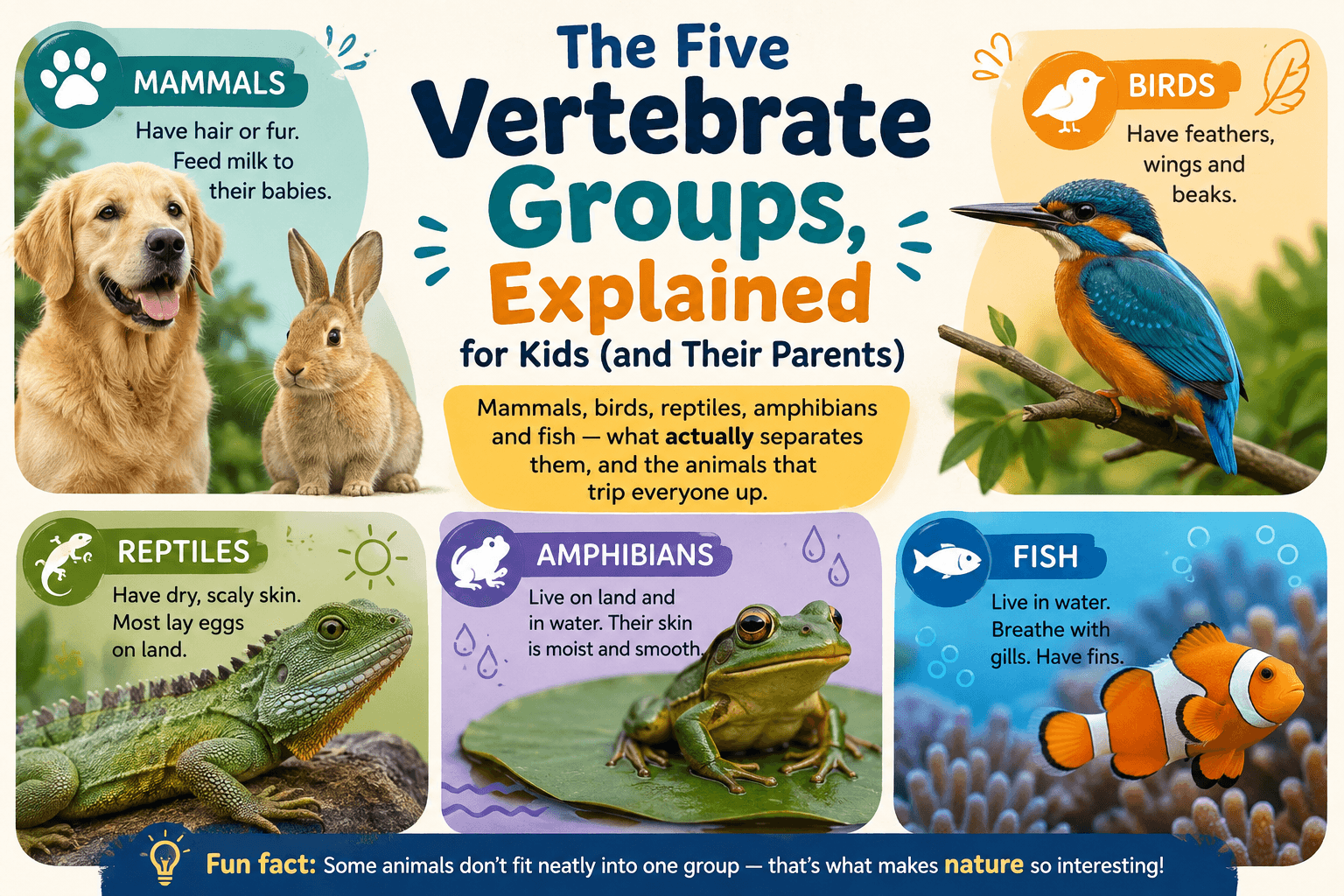
The Five Vertebrate Groups, Explained for Kids (and Their Parents)
Mammals, birds, reptiles, amphibians and fish — what actually separates them, and the animals that trip everyone up.
Sorting animals into groups is one of the first pieces of real science a child does. It looks like memorisation and it is not: the whole point is learning to classify by a rule you can state, rather than by what something looks like at a glance.
That distinction is why whales cause so much trouble.
What "vertebrate" means
A vertebrate is an animal with a backbone. That is the entire definition. Everything else — fur, feathers, scales, gills, lungs — comes later, when we divide the vertebrates into their five groups.
Most animals on Earth are invertebrates: insects, spiders, worms, snails, jellyfish, crabs. They vastly outnumber vertebrates. The five groups below are all subdivisions of the much smaller vertebrate branch.
The five groups
Mammals
- Have fur or hair at some point in their life
- Feed their young with milk
- Breathe air with lungs
- Are warm-blooded — their body stays at a steady temperature
Examples: dogs, humans, bats, whales, mice, elephants.
Birds
- Have feathers — the one feature no other group has
- Have a beak and no teeth
- Lay hard-shelled eggs
- Are warm-blooded
Examples: sparrows, eagles, penguins, ostriches, chickens.
Reptiles
- Have dry, scaly skin
- Lay soft-shelled eggs on land, or give birth to live young
- Breathe air with lungs
- Are cold-blooded — their temperature follows their surroundings
Examples: snakes, lizards, turtles, crocodiles.
Amphibians
- Have moist, smooth skin with no scales
- Start life in water with gills, then usually develop lungs
- Lay jelly-like eggs in water
- Are cold-blooded
Examples: frogs, toads, newts, salamanders.
Fish
- Have scales and fins
- Breathe underwater through gills
- Lay eggs in water
- Are cold-blooded
Examples: salmon, sharks, goldfish, tuna.
The animals that trip everyone up
This is the part worth spending time on, because these are the cases that reveal whether a child is classifying by rule or by appearance.
Whales and dolphins are mammals
They live in the sea, they are shaped like fish, and they swim. But they have no gills — they surface to breathe air with lungs, they feed their calves milk, and they are warm-blooded. Every rule that matters says mammal. Habitat is not one of the rules.
Penguins are birds
They cannot fly and they swim beautifully, which makes them feel like they belong somewhere else. But they have feathers, a beak and hard-shelled eggs. Flying was never part of the definition.
Bats are mammals
They fly, but they have fur, not feathers, and they feed their young milk. They are the only mammals capable of true flight.
Frogs are amphibians, not reptiles
Both are cold-blooded and both can look scaly at a glance. The difference is the skin — a frog's is moist and smooth — and the life cycle, which starts in water with gills.
Sharks are fish
Large, fast and dangerous does not make an animal a mammal. Sharks have gills and fins, and they are cold-blooded.
How to practise this at home
Classification responds well to being done out loud, and badly to being read.
- Insist on the rule. Before your child sorts anything, ask them to say what they are sorting by. "I am grouping by whether it has feathers" is science. "These ones look similar" is not.
- Use the hard cases deliberately. A pile of dogs, cats and sparrows proves nothing. Put a whale, a penguin, a bat and a frog in the pile and the reasoning has to become explicit.
- Ask "how do you know?" every time, including on the easy ones. The goal is a child who can defend an answer, not one who produces it quickly.
- Build a branching key. Start with "does it have a backbone?", then "does it have feathers?", and keep splitting. Making the key is far more instructive than using one.
Why this matters beyond the test
Classification is the first time a child has to hold a definition steady against something that looks like a counter-example. A whale really does look like a fish. Choosing the rule over the appearance — and being able to say why — is a habit that shows up again in every subject, and it is genuinely difficult the first few times.
It is also why "wrong" answers here are worth discussing rather than correcting. A child who says a whale is a fish has noticed something real. The interesting conversation is about which of the things they noticed actually count.
Practising with PetMat
Vertebrate groups, adaptations and classification keys sit in the nature curriculum for ages 9–10, alongside the body systems work that runs through the same year. Younger children meet a simpler version — grouping animals by visible features — in the ages 7–8 hub.
If you would rather work on paper, the free printable nature worksheets include an answer key and need no account. And 7 Differences is a surprisingly good warm-up for this topic: it trains exactly the careful, systematic looking that classifying by rule depends on.