Animals of the World for Kids: A Continent-by-Continent Guide with Map
68 animals of the world sorted by continent, with their habitats, food chains and amazing facts, plus an interactive map and globe to explore them with your child.
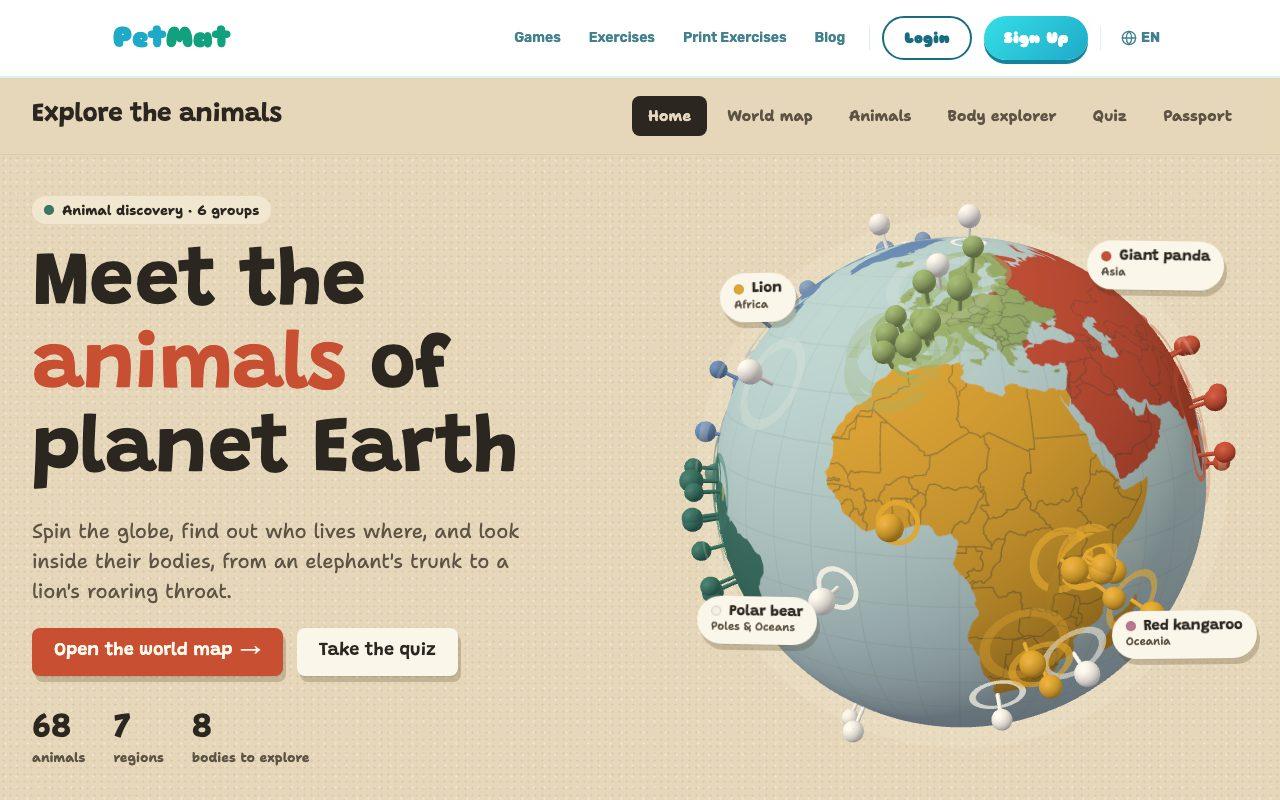
"Which animals live in Africa?" "What's the biggest animal in the world?" "Does a polar bear live with penguins?" Children ask these questions all the time, and they are a great way into geography, science and reading.
This guide answers them continent by continent. It covers the 68 animals of the world in PetMat's animal explorer, with a fact for each one that kids love to repeat at dinner. Every animal name links to its own profile page, with photos, size, speed, diet and conservation status.
Animals of the world, continent by continent
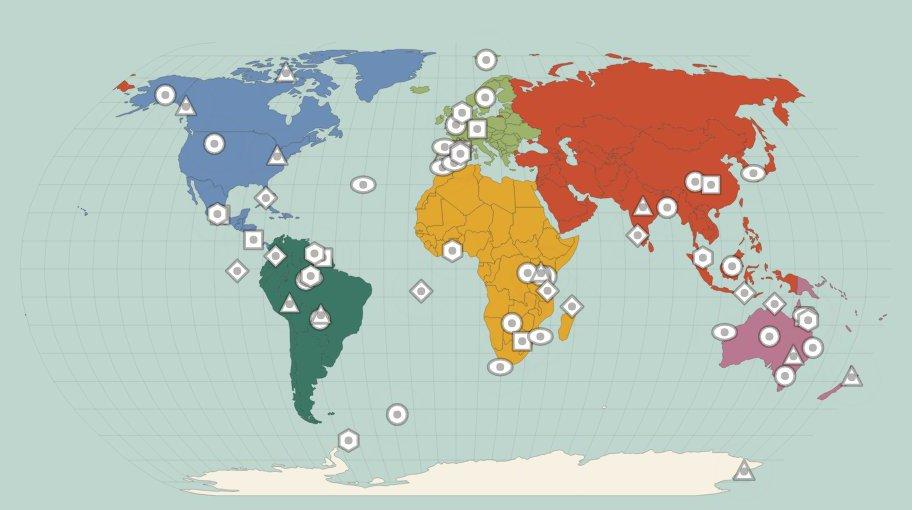
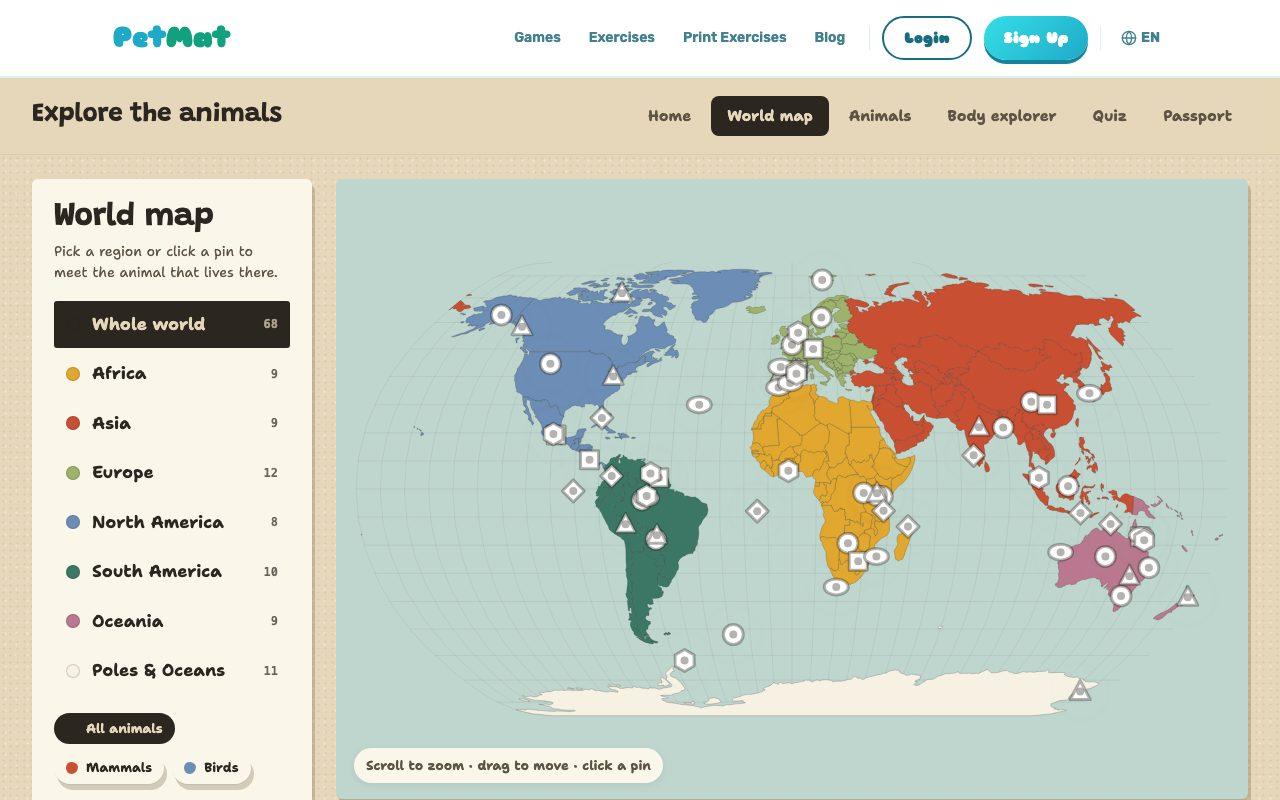
The world map splits the planet into seven regions: Africa, Asia, Europe, North America, South America, Oceania, and the poles and oceans. Each region has its own colour, and every pin is an animal. Clicking a pin opens its card.
Animals of Africa
Africa is home to the big animals of the savanna, but also to rainforest and wetland animals.
- African elephant: the biggest animal walking on land. It eats up to 150 kg of plants every day.
- Lion: the only cat that lives in big family groups, called prides. Its roar can be heard up to 8 km away.
- Giraffe: the tallest animal alive. Its neck has 7 bones, the same number as yours.
- Ostrich: the biggest bird in the world. It can't fly, but it runs at 70 km/h.
- Mountain gorilla: it shares about 98% of its DNA with humans.
- Nile crocodile: Africa's biggest reptile. It can go months without eating.
- Also on the map: the panther chameleon, the emperor scorpion and the African bullfrog.
Animals of Asia
Asia goes from cold mountain forests to steamy rainforests.
- Bengal tiger: the largest wild cat. Its skin is striped too, not just its fur.
- Giant panda: it eats 12 to 38 kg of bamboo a day.
- Bornean orangutan: the largest tree-living animal. Its arms are longer than its legs.
- Komodo dragon: the biggest lizard alive, with a venomous bite.
- King cobra: the longest venomous snake in the world. It mostly eats other snakes.
- Also on the map: the Indian peafowl, the Atlas moth, the Japanese pufferfish and the Chinese giant salamander, the biggest amphibian in the world.
Animals of Europe
Europe has plenty of wildlife close to home, from gardens to the Pyrenees.
- Golden eagle: it can spot a rabbit about 3 km away and dives at over 240 km/h.
- Eurasian lynx: its wide, furry paws work like snowshoes.
- European hedgehog: it has 5,000 to 7,000 spines and rolls into a ball when scared.
- Long-snouted seahorse: the father carries the eggs in a pouch and gives birth.
- Common octopus: it has three hearts and blue blood.
- Also on the map: the white stork, the honeybee, Hermann's tortoise, the fire salamander, the common frog, the Atlantic salmon and the bluefin tuna.
Animals of North America
North America has huge bears, giant herds and tiny hummingbirds.
- Grizzly bear: the hump on its shoulders is muscle for digging.
- American bison: the heaviest land animal in North America. It can jump almost 2 m high.
- Axolotl: it can regrow its legs, its tail and even parts of its heart.
- Monarch butterfly: some fly about 4,000 km to forests in the mountains of Mexico.
- Also on the map: the bald eagle, the ruby-throated hummingbird, the American alligator and the red-eyed tree frog.
Animals of South America
South America holds the Amazon rainforest, one of the richest habitats on Earth.
- Jaguar: the biggest cat in the Americas, and it loves water.
- Capybara: the largest rodent in the world, with slightly webbed feet for swimming.
- Scarlet macaw: a bright red parrot that eats clay from riverbanks.
- Dyeing poison frog: it gets its poison from the ants and mites it eats.
- Also on the map: the toco toucan, the red-bellied piranha, the green iguana, the Goliath birdeater, leafcutter ants and the Santa Cruz giant tortoise, which can live more than 100 years.
Animals of Oceania
Oceania has animals found nowhere else in the world.
- Red kangaroo: the largest marsupial. It can cover 8 m in a single hop.
- Koala: it sleeps 18 to 22 hours a day.
- Platypus: one of the only mammals that lays eggs.
- North Island brown kiwi: the only bird with nostrils at the tip of its beak.
- Also on the map: the emu, the frilled lizard, the cane toad, the clownfish and the crown-of-thorns starfish.
Animals of the poles and oceans
The poles and oceans region covers the Arctic, Antarctica and the open sea.
- Blue whale: the biggest animal that has ever lived. Its heart weighs about 180 kg.
- Polar bear: its skin is black under see-through fur.
- Emperor penguin: it can dive deeper than 500 m. And no, it never meets polar bears: penguins live in the south, polar bears in the Arctic.
- Whale shark: the biggest fish in the world, yet it only eats tiny plankton.
- Also on the map: the great white shark, the giant manta ray, the snowy owl, the green sea turtle, the humpback anglerfish, the moon jellyfish and Antarctic krill.
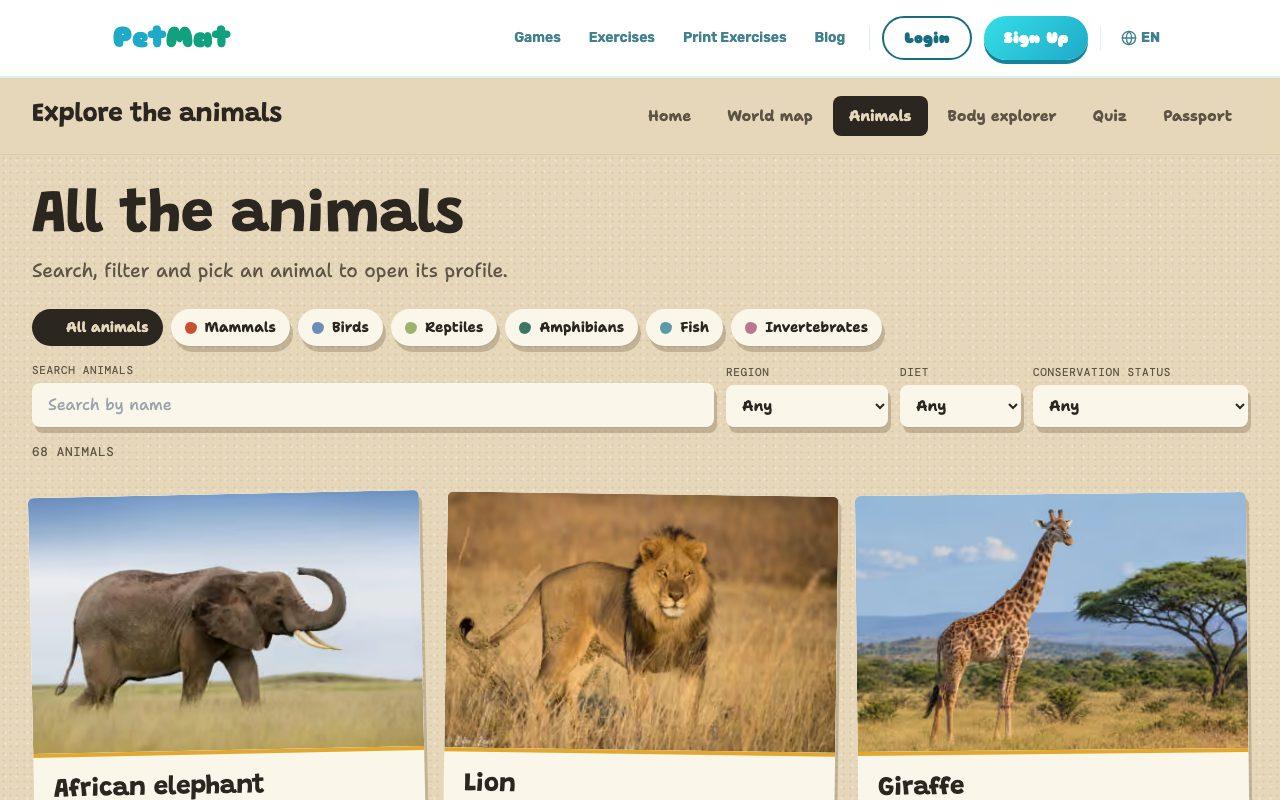
Want to see all 68 at once? The list of all animals lets kids filter by group, region, diet and conservation status.
Where animals live: habitats for kids
A habitat is the place where an animal finds food, water and shelter. The same continent can have very different habitats, which is why an elephant and a crocodile both live in Africa. The main ones in the explorer are:
- Savanna: warm grassland with a few trees. Elephants, lions, giraffes and ostriches.
- Rainforest (jungle): hot, wet and full of trees. Orangutans, jaguars, macaws, poison frogs and leafcutter ants.
- Forests and taiga: tigers, koalas, toucans, lynxes and grizzly bears.
- Mountains: mountain gorillas, giant pandas and golden eagles.
- Deserts and dry grasslands: red kangaroos, emus and Komodo dragons.
- Wetlands, rivers and lakes: crocodiles, capybaras, platypuses and axolotls.
- Polar regions: polar bears, emperor penguins and snowy owls.
- Oceans and coral reefs: whales, sharks, octopuses and clownfish. Some live in the deep sea, like the anglerfish, which waits in total darkness around 1,000 m down.
A good question to ask your child: why would a polar bear struggle in the jungle? Talking about fur, food and temperature is the start of the idea of adaptation.
Who eats whom: food chains for kids
A food chain shows how energy passes from one living thing to another. It always starts with a producer, a plant or alga that makes its own food from sunlight. Then come the consumers:
- Herbivores (primary consumers) eat plants: elephants, giraffes, pandas, koalas, kangaroos.
- Carnivores eat other animals. Some are hunted in turn; others sit at the top.
- Apex predators have no natural enemies as healthy adults: lions, tigers, polar bears, golden eagles and great white sharks.
- Omnivores eat both plants and animals: grizzly bears, ostriches, toucans.
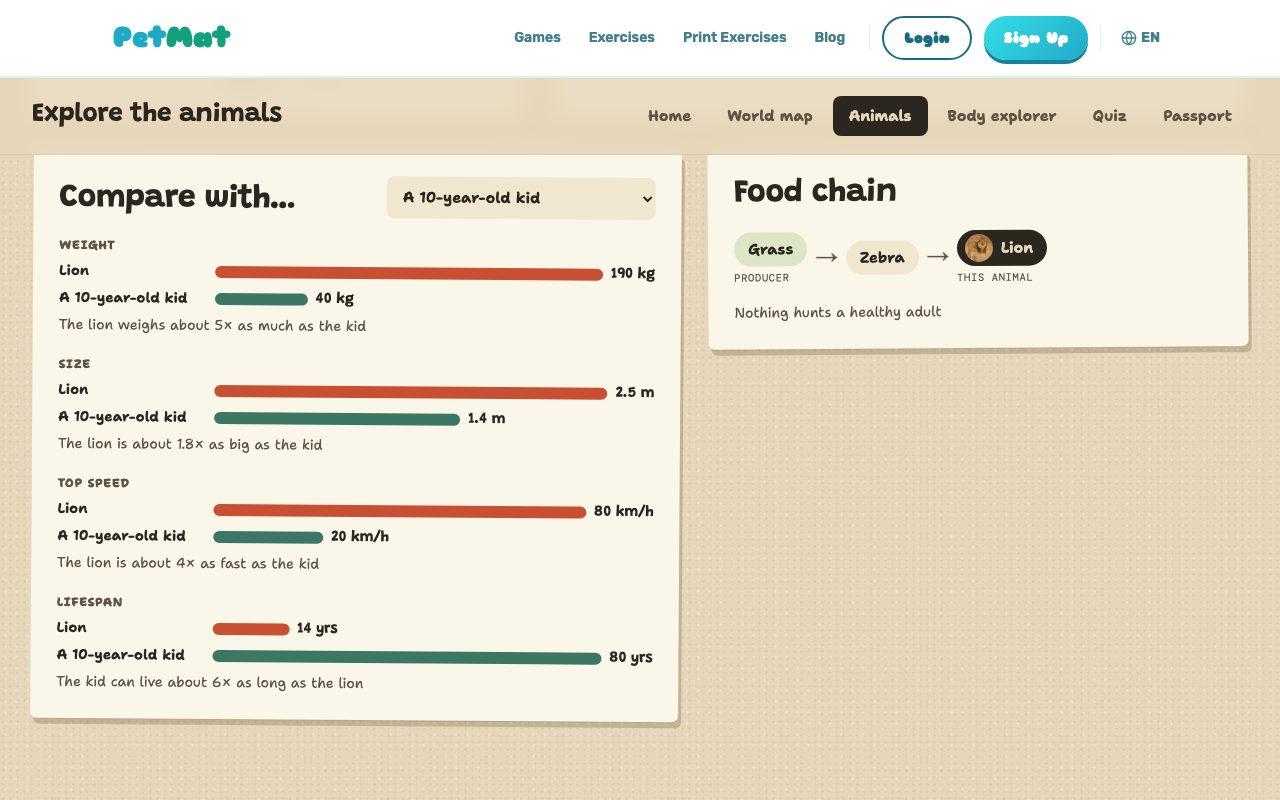
Every animal page in the explorer shows its food chain. For the lion it is grass, then zebra, then lion. A nice surprise for kids: the blue whale, the biggest animal ever, feeds on krill, which feed on tiny algae.
Look inside an animal's body
The body explorer shows eight animals from the outside, their skeleton and their organs: the African elephant, lion, polar bear, golden eagle, Nile crocodile, common frog, great white shark and honeybee. Kids tap each part to read what it does, and collect stamps as they go.
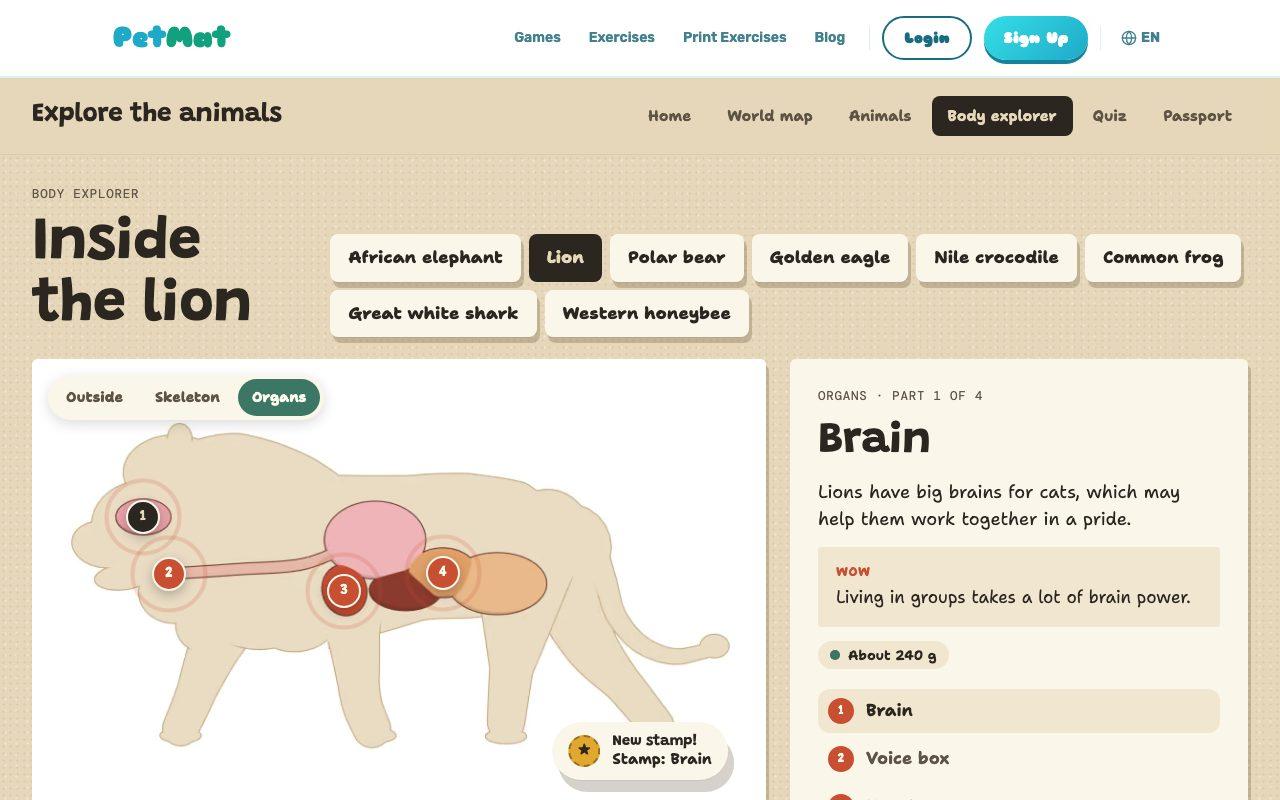
It pairs well with our human body explorer: comparing a lion's heart with ours is a great way to talk about mammals.
Mammals, birds, reptiles, amphibians, fish and invertebrates
The explorer groups animals into six groups. The first five are the vertebrates, animals with a backbone, and the sixth is the invertebrates, like bees, octopuses and spiders. If your child is learning to classify animals at school, read our guide to the 5 vertebrate groups and their characteristics, with the animals that trip everyone up.
5 activities to learn about animals of the world at home
- Animal of the day: open a random profile at breakfast and share one fact each.
- Continent challenge: name an animal, and your child has to find its continent on the world map.
- Build a food chain: draw a producer, a herbivore and a carnivore from the same habitat, and join them with arrows pointing from food to eater.
- Compare with me: every profile compares the animal's weight, size, speed and lifespan with a child. Ask your child to guess first.
- Take the quiz: the animal quiz has photo questions and an 8-round challenge with maps, clues, bodies and food chains.
Questions parents ask
What are the animals of the world by continent?
Each continent has its own famous animals: elephants and lions in Africa, tigers and pandas in Asia, lynxes and golden eagles in Europe, bison and grizzly bears in North America, jaguars and capybaras in South America, and kangaroos and koalas in Oceania. Polar bears and penguins live at opposite poles.
What is the biggest animal in the world?
The blue whale, which can weigh up to 150,000 kg. It is the biggest animal that has ever lived, dinosaurs included. On land, the biggest is the African elephant, at up to 6,000 kg.
What is the tallest animal?
The giraffe. Its long neck lets it reach leaves that no other animal can.
At what age can children start learning about animals of the world?
From about 6, kids enjoy the map, the photos and the facts. From 8 to 12 they can work with habitats, food chains and classification, which is what the quiz and our nature exercises by school year cover.